With FYERS Academy, I wanted to explore whether learning could change how people approached trading. Giving people more content was easy to imagine. The harder question was what would help them put what they learned into practice.
- My role
- I led the FYERS Academy experiment and the development of a Human + AI content workflow.
- What changed
- The Product team reused the workflow
Academy did not proceed, but the team used what we built to create product explainer videos.
See how the Product team reused the workflow
Sometimes the right answer was not to build.
Becoming Chief Innovation Officer moved my work upstream. In the Innovation Lab, we investigated opportunities FYERS wasn’t yet certain it should pursue.
We received strategic questions rather than an agreed roadmap. The team turned them into hypotheses, researched them, challenged assumptions and looked for evidence to recommend pursuing an opportunity or walking away.
For much of my career, a product had been waiting at the end of the ambiguity. Here, that guarantee disappeared. Progress could mean eliminating an idea before it became expensive.
We wanted learning to change behaviour.
Financial education was one opportunity. The question wasn’t whether we could build courses. There was already plenty of content. We asked how people actually learn to make better financial decisions.
Knowing what a stop-loss is doesn’t mean using one when money is at stake. Understanding diversification doesn’t guarantee a diversified portfolio.
Learn Practice Dashboard
Understand a concept, try it, then see evidence of progress. The ambition was to connect knowledge with behaviour.
These screens have been adapted for this portfolio to respect the confidentiality of an unreleased FYERS product. They illustrate the learning experience and design approach, rather than reproduce the application as built.
Two ways to build understanding.
Learn combines video tutorials, puzzles, quizzes and tests. Practice uses market missions for deliberate practice. A lesson may connect to a related mission, but the two modules aren’t a fixed sequence.
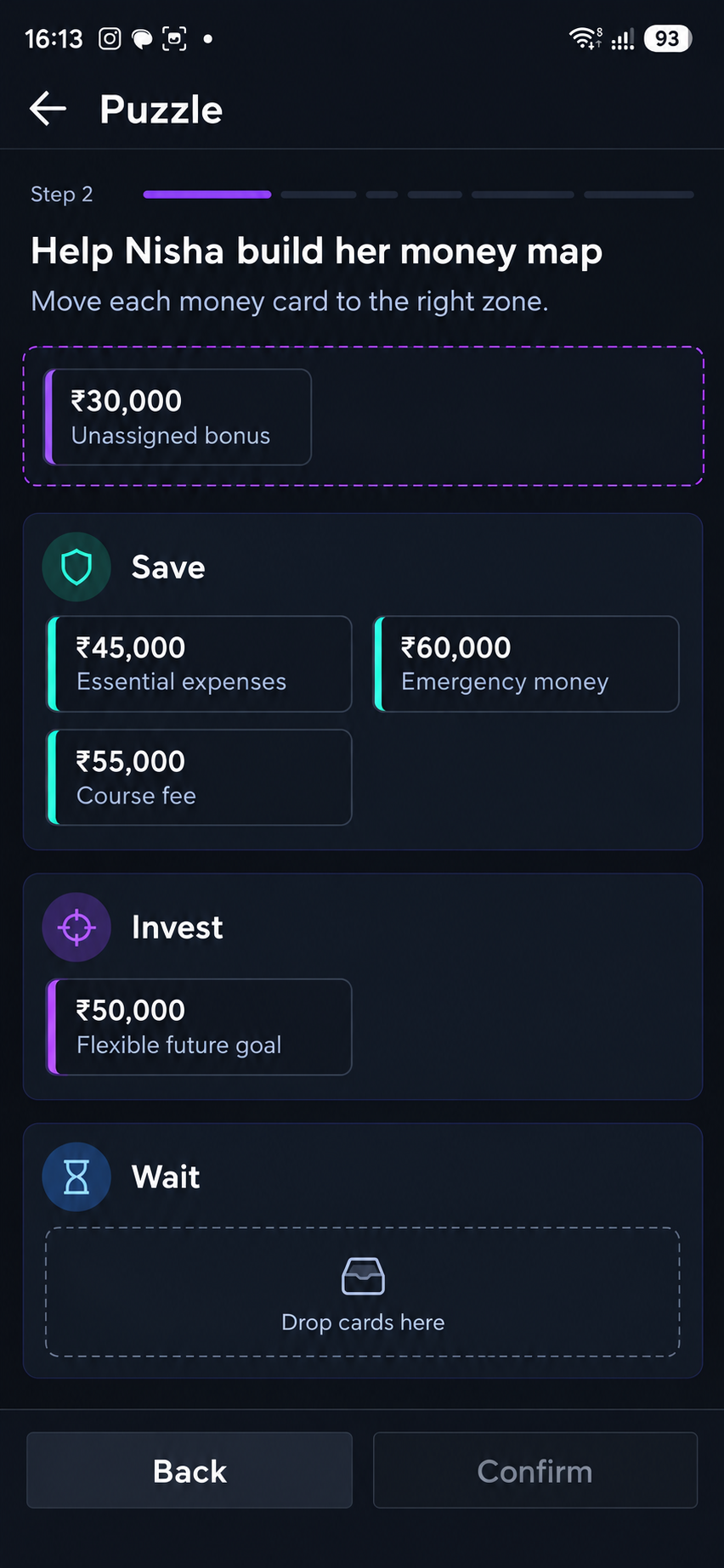
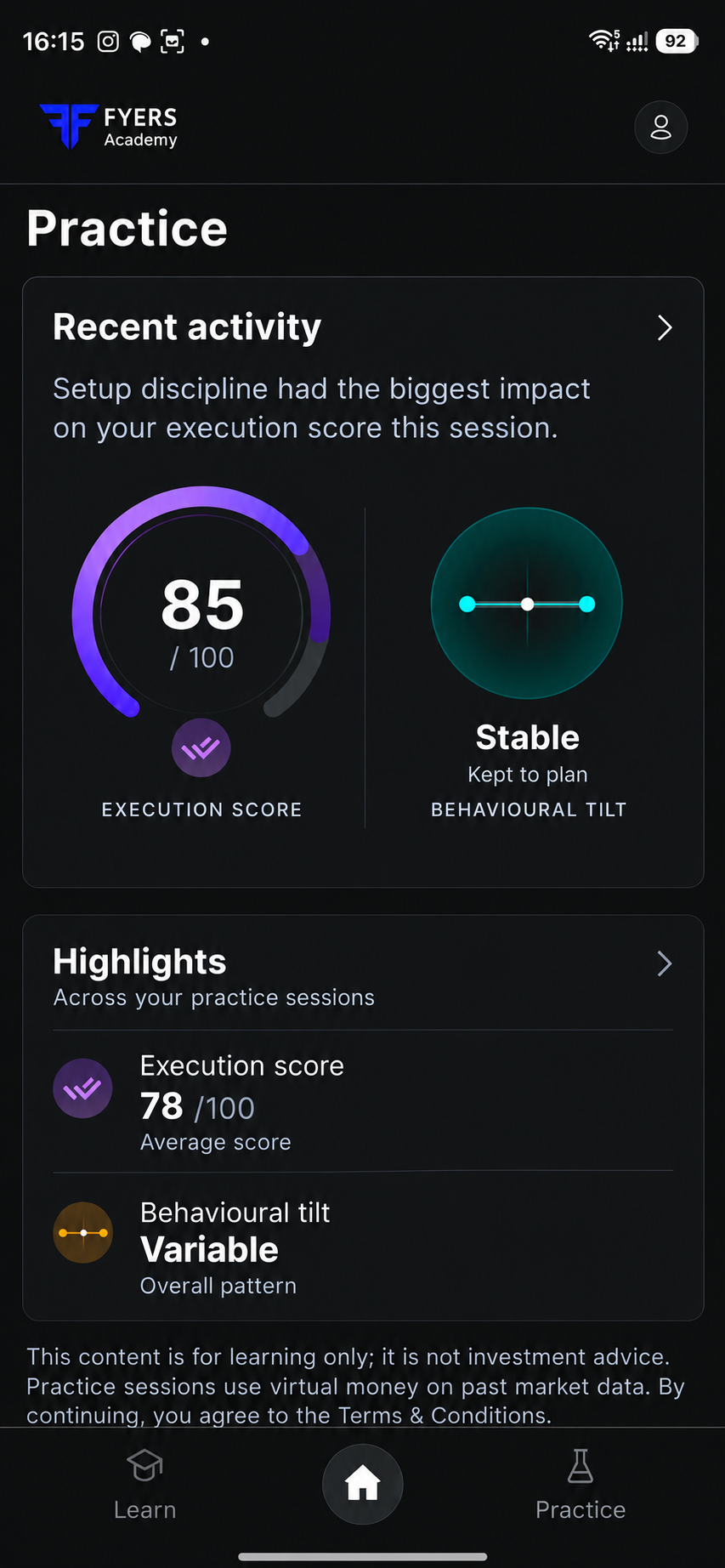
The work became FYERS Academy. Two designers researched, designed and developed the application using an AI-assisted workflow. They carried the work from understanding the problem to reviewing a running application. AI did much of the execution; the designers shaped the experience, questioned the output and decided what met the bar.
Sujith’s account of the workflow on another FYERS project
Making the idea tangible helped us investigate it. It also brought the Lab closer to product delivery than its original research-and-recommendation mandate.
The capability travelled beyond Academy.
Educational products need substantial content. Having senior leadership record every lesson would consume executive time. I began questioning whether we could remove that repeated production constraint.
One subject-matter expert and one designer created the learning content, from the syllabus and training videos to puzzles and the final certification test. The capability went beyond producing videos. It connected subject expertise, learning design and AI-assisted production into a repeatable workflow.
The team experimented with synthetic voice, generated visuals, video tools and automation. We developed a workflow capable of creating a realistic digital presenter, reducing the need for a senior leader to physically record each lesson.
A digital presenter, built through the workflow.
A short sample of the AI-generated presenter we created for Academy, combining subject expertise, design judgement and AI-assisted production.
The Product team began using the capability for product-explainer videos.
That was the concrete result beyond Academy: a Human + AI content-production workflow useful elsewhere in FYERS. The Product team didn’t need Academy to proceed in order to benefit from it.
The product stopped. The commitment questions arrived too late.
Academy had moved through research, product thinking, design, content systems and substantial frontend implementation. Completing it required deeper commitment from Product and Technology.
Leadership reconsidered whether confidence in the opportunity justified continued investment and decided not to proceed. I had a different view, but companies should be able to change direction as evidence, strategy and resource priorities change.
The question I took away was why confidence, investment and ownership had become decisive so late. An innovation team can investigate and prototype; it cannot create Product ownership, engineering capacity and executive commitment by itself.
Freedom to experiment needs a path to commitment.
This experience shaped the model I would use now. It wasn’t a framework that had governed Academy from the start.
- HypothesisWhat do we believe might be true?
- EvidenceWhat would increase or decrease confidence?
- DecisionStop, investigate further, or pursue?Stop: retain the learning. Investigate: return to the hypothesis and evidence. Pursue: consider commitment.
- InvestmentWhat people, capital and capacity will we commit?
- OwnershipWho is accountable for turning it into a product or business?
Evidence doesn’t automatically justify investment. A promising opportunity can still be the wrong place to commit resources. Investment without ownership can leave a project everyone supports but nobody is accountable for delivering.
Academy gave us a product concept, evidence, experience with AI-assisted development and a reusable content capability. It also showed me what I would design differently next time: the path from experimentation to commitment.
The purpose of innovation isn’t to make every experiment succeed. It’s to make sure every serious experiment leaves the organisation with something useful: a product, a capability, evidence, or a better decision not to proceed.
Explore another capability built for reuse